Devlog #11: A Clock in the Larder
Food used to be a number that only went up. Now every kind of it has a deadline, the map gives six things you cannot grow at home, and an army that eats turns your storehouse into a decision.
Posted 2026-10-21 · Foundation MVP phase
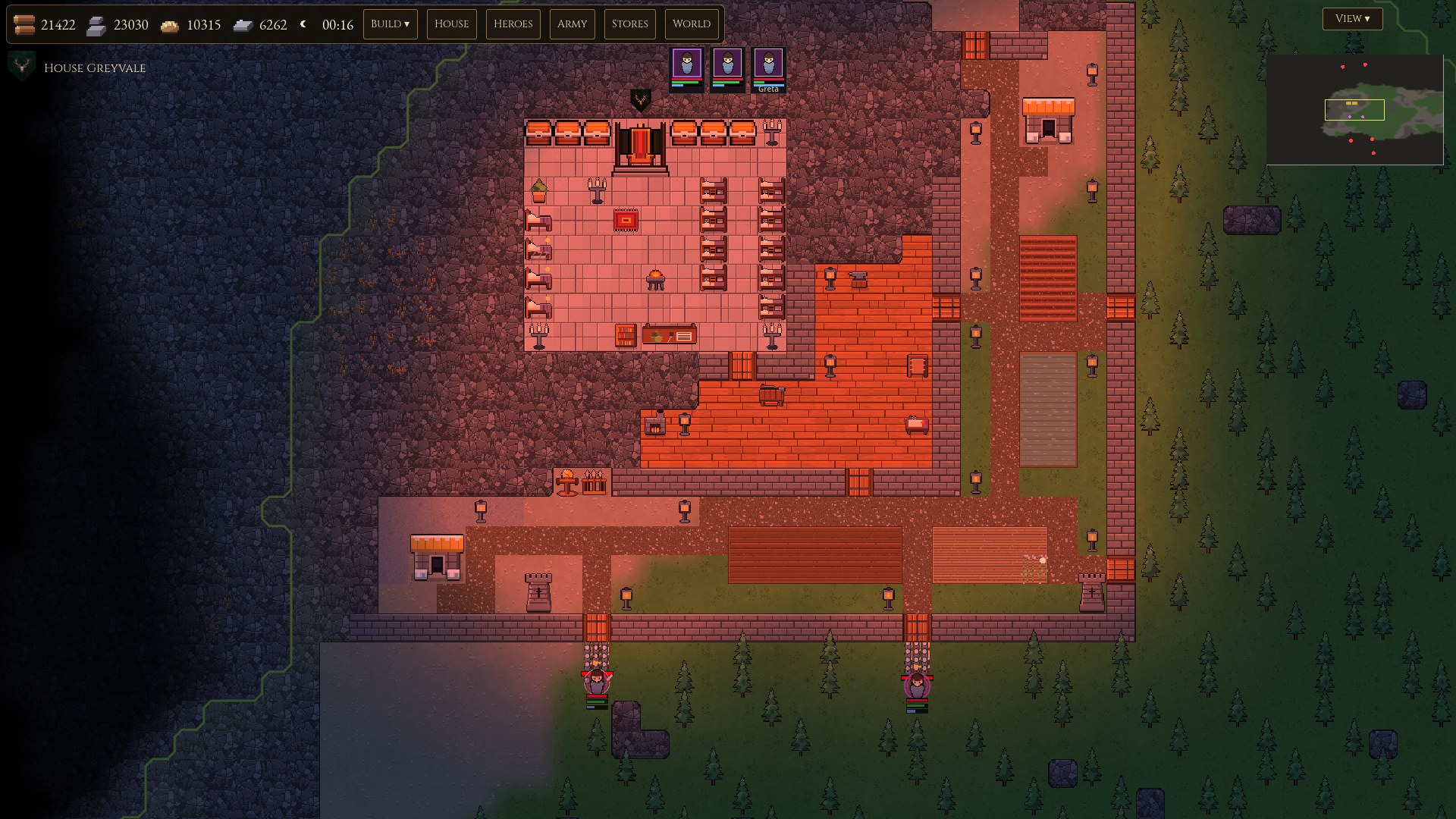
For most of this game's life, food was a number that only went up.
You cut wheat, the number went up. Your heroes ate, the number went down a little. There was no reason to ever stop filling chests, no reason to prefer one crop to another, and no reason to care where in the world you were standing when you harvested. A storehouse was a score.
This week the storehouse became a decision.
Food is not an item any more
There used to be one thing called "food". Today there are four raw foods, each with its own deadline, plus what you cook out of them.
| Keeps for | |
|---|---|
| Raw meat | 2 days |
| Cooked meal | 4 days |
| Wheat | 5 days |
| Potato | 8 days |
| Rice | 20 days |
| Ration | forever |
Those are real days, not game days. And the deadline is hard: a batch does not shrink a little every hour, it sits there and then it is gone. Wood, stone and iron never rot, because they are the stable half of the economy and it would be misery if they did not exist.
Your larder reads batch by batch: "20 wheat, 1 day left; 30 rice, 18 days". One total would hide exactly the thing you need before deciding whether to cook tonight.
And anything that eats takes the most perishable thing first. Your troops, your heroes, the garrison of an outpost: all of them reach for the meat before the rice. That one rule makes the larder manage itself, and turns the thing that was about to spoil into dinner.
Three ways out
Cook it. Every raw food has one recipe at the campfire and one at the stove, and the bench decides the yield: a campfire turns three raw into one meal, a stove into two. A meal fills 70 hunger against wheat's 40, and it buys you a few days.
Preserve it. Rations never spoil. They also fill 25 instead of 40 and give no cheer at all, which is the trade: you are paying in morale for a number that never moves.
Build a cold store. The Icehouse takes 2x2 of floor against a chest's single tile, refuses anything that is not food, and inside it every deadline lasts thirty times longer. Meat goes from two days to sixty. Wheat goes from five to a hundred and fifty. Not "forever": a number you can feel is a number you can balance, and "never" is not something you can calibrate by playing.
Your heroes carry perishables to the Icehouse before the chest, on their own, because otherwise you would be filling it by hand.
Leather got the same clock
Raw hide now rots in twenty days, and the thing that saves it is the tanning rack.
The rack used to be where armour was made. Now it is the step between hunting and building: it turns raw hide into tanned leather, which never rots, and the armour and the seven pieces of furniture that used to ask for raw hide ask for leather instead. Tanning costs work, not materials, so nothing got more expensive in animals. What changed is that there is a hero's trip between the kill and the workshop.
Four crops, four clocks
A farm plot now has a crop, chosen when you plant it, and the crop is the tile: a rice paddy draws as a rice paddy, water against earth, without the server sending anything extra.
What separates them is time. Wheat ripens in four minutes and yields two. Potato takes six and yields two. Rice takes ten and yields three.
Without that, there was no choice to make: potato fills more than wheat and keeps longer than wheat, for the same tile and the same hour, so potato simply won. With the clocks, whoever is short of land plants wheat, whoever is short of heroes plants rice, and whoever is stockpiling plants rice again, for the twenty days.
Why any of this bites: armies eat
A House with eight chests holds eight hundred food. Forty tier-1 spearmen eat nine hundred and sixty a day.
That is the whole point of putting a clock in the larder. A standing army is not a number you reach, it is a number you feed, and an empty larder means a soldier deserting every ten minutes, cheapest to replace first. You find out when you log back in, because the House writes down what happened while you were away.
And the map finally pays differently
Until this week, a chunk of tundra and a chunk of grassland gave you exactly the same wood and the same stone. Five rings and thirty-five named regions were geography, not economy.
Now every biome has one thing that only it gives, and it comes out of the node that was already there. One harvest in ten comes back with it instead of the ordinary drop.
- Forest gives Greatwood
- Grassland gives Aurum Wheat
- Mountain gives Mountain Stone
- Swamp gives Mire Hide
- Tundra gives Frost Hide
- The Wastes give an Ancient Relic
Each of them does something. Golden wheat is the best raw food in the game, 55 hunger and 10 cheer against wheat's 40 and 5, and it cooks into one extra, because otherwise cooking the good stuff would be throwing away what makes it good. The two biome hides tan five for three instead of three for three, which is the same labour giving you two more leather. The relic out of the Wastes turns into sixty research points at the research table, which is an hour of a researcher's work for something you carried home.
And Greatwood and Mountain Stone become walls. The ladder used to be palisade at 100 hit points and stone wall at 300. It is now palisade 100, stone wall 300, Greatwood palisade 400, granite wall 800. They cost the same number of units as the two below them. What changed is that the unit only drops one harvest in ten, in the biome that has it.
The distribution is deliberately uneven
Ring 1, the outer edge where every new House is founded, draws from rock, grassland and forest. So a new House can reach three of the six without leaving home.
Swamp, tundra and the Wastes belong to rings 3, 4 and 5, which is the direction of the centre, which is the direction of everybody else. The pull inward now has a price tag written on it.
Also this week
The night is drawn differently. Every torch used to be a light object, and the renderer applies at most fourteen of those to any one surface. The ground is drawn as one sprite per 50x50 chunk, so in a base with nineteen lamps, five of them lit nothing at all, and which five depended on the order of the scene. Lights also added up and blew out the colour: at the hot spot the ground read as flat grey with its texture gone. Both are gone. Light is now one full-screen pass that reads the frame and rewrites it, there is no limit on how many lamps you can light, and 0.00% of the image loses its colour. The picture at the top of this post is what that looks like.
The interface has five doors instead of nine. House, Heroes, Army, Stores, World, plus Build as a mode. The old complaint was never that it was ugly: it was that nothing told you where anything lived, and some things, like your garrison, only existed if you knew to click the right object in the world. Now every destination has a door at the top of the screen and a key, and clicking the thing in the world is a shortcut into that destination rather than a panel of its own.
And the Steam page is up
As of today, Stand Eternal has a Steam page. There is nothing to buy on it and nothing to install. If you want to be told when there is, the wishlist button is the thing that does it, and it is the single most useful thing anyone reading this can do for the game.
Stand Eternal is a 24/7 civilisation MMO with one world, no pay-to-win, and the same game on PC and mobile. It is in development, and the devlog is how I show the work.
The conversation happens on Discord.